



Cyber threats don’t exist in isolation. An exposed server, a phishing domain impersonating your brand, and malicious infrastructure communicating with your network may be connected. Extended threat intelligence (XTI) tools help security teams identify these risks by combining external asset visibility, digital risk protection, and threat intelligence in one platform.
XTI brings together three core capabilities: external attack surface management (EASM), digital risk protection services (DRPS), and cyber threat intelligence (CTI). Instead of analyzing each separately, organizations can connect external exposures, brand threats, and malicious activity to understand which risks require attention.
In this article, we’ll compare 11 XTI platforms and related solutions, examining their capabilities, strengths, limitations, and suitability for different security teams.
H2: What Is Extended Threat Intelligence (XTI)?
Extended threat intelligence (XTI) is an approach to cybersecurity that combines external attack surface management (EASM), digital risk protection services (DRPS), and cyber threat intelligence (CTI) to provide a more comprehensive view of an organization’s external threats.
- EASM discovers internet-facing assets, identifies vulnerabilities, and continuously monitors exposures.
- DRPS identifies risks to an organization’s digital presence, such as phishing domains, brand impersonation, and other forms of digital abuse.
- Threat intelligence adds context about malicious infrastructure, threat actors, exploitation activity, and emerging attacks.
By bringing these capabilities together, XTI helps security teams move beyond isolated alerts. They can connect threats to specific assets and digital risks, prioritize investigations, and make better-informed security decisions.
XTI platforms vary in scope: some emphasize dark web and brand monitoring, while others focus on attack surface visibility, vulnerability intelligence, or network activity.
Top 11 Extended Threat Intelligence Platforms
XTI is a relatively new term in cybersecurity, and Gartner hasn’t formally defined it as a category (unlike EASM or DRPS, for example). As a result, while some vendors position their platforms as XTI solutions, others use terms like advanced exposure management or external threat intelligence.
We selected the following 11 platforms because they combine different elements of extended threat intelligence, including attack surface discovery, digital risk protection, threat intelligence, and exposure prioritization. Some offer all three core XTI capabilities — EASM, DRPS, and CTI — while others specialize in certain areas but provide at least some coverage of the remaining capabilities.
1. Attaxion LiveSight: XTI with NetFlow-Enhanced Threat Intelligence
Attaxion LiveSight is an exposure-management and threat-monitoring platform combining external attack surface management, domain-based digital risk protection, and actionable threat intelligence. It helps security teams discover exposed assets, identify vulnerabilities, detect brand impersonation threats, and investigate malicious network activity using global aggregated NetFlow data. Unlike platforms that rely primarily on external threat feeds and asset scanning, LiveSight adds near-real-time network communication intelligence, helping organizations understand which exposed assets are actively communicating with suspicious or malicious infrastructure.
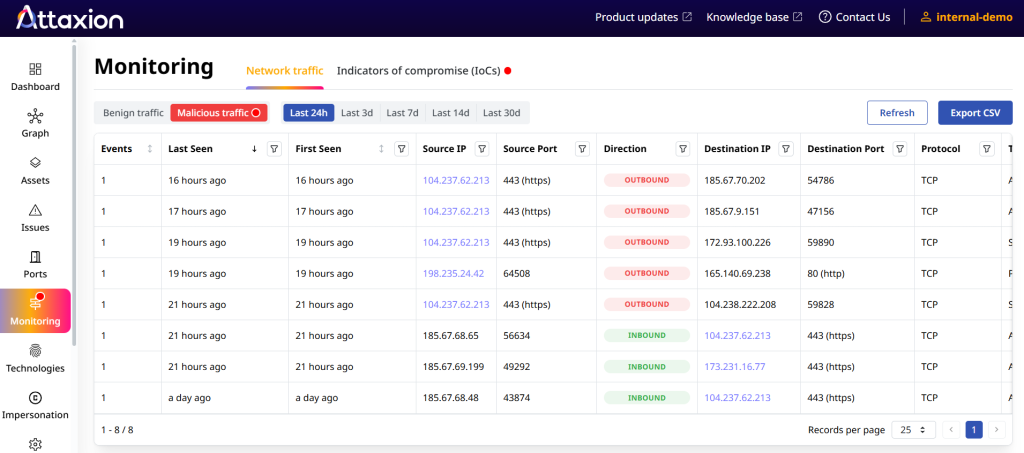
Primary focus: Unified external threat visibility across attack surface exposures, domain-based digital risks, and malicious network activity, with NetFlow-enhanced threat intelligence for prioritization and investigation.
Pros:
- Agentless setup, so there’s nothing to deploy on target systems
- Uses global aggregated NetFlow data to show your organization’s active assets and ports and what other IP addresses and ports they are talking to.
- Draws asset-to-asset relationship graphs, which helps trace potential attack paths
- Pulls in multiple industry-standard threat feeds and scoring systems, including CVSS, EPSS, and CISA KEV
- Combines EASM, domain-based digital risk protection, and threat intelligence in a single platform
- Continuously monitors new domain registrations to detect potential brand impersonation, phishing, and typosquatting
- Correlates asset vulnerabilities with real network activity and malicious IP intelligence to help prioritize relevant threats
Cons
- It focuses on external assets only, not covering internal ones
- Fewer third-party integrations than some larger platforms
- Reporting is not as customizable as what other platforms offer
2. Check Point Exposure Management
Check Point acquired Cyberint in 2024 and initially rebranded it as Infinity External Risk Management. Now Check Point has folded that product together with another acquisition — Veriti — into a broader offering called Check Point Exposure Management. It correlates assets, brands, and third-party relationships with threat intelligence to identify, prioritize, and mitigate external threats and exposures. Its combination of attack surface visibility, digital risk protection, and threat intelligence aligns with the XTI approach.
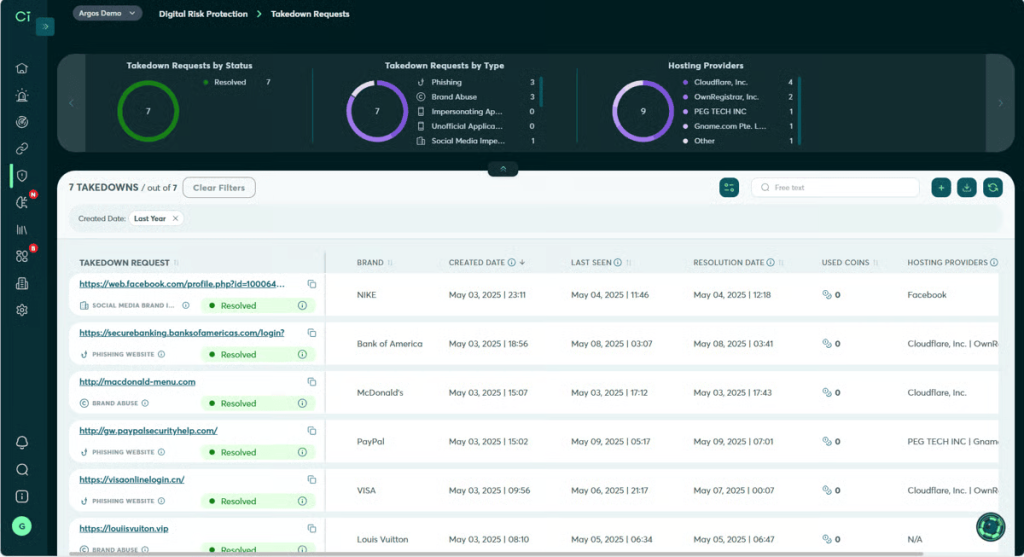
Primary focus: Unified external risk management across attack surfaces, digital risks, threat intelligence, and third-party exposure.
Pros:
- Reviewers consistently point to strong dark web monitoring and early detection of leaked credentials and phishing
- Direct line into Check Point’s broader enterprise security ecosystem, useful if you’re already a Check Point customer
- Rated highly for ease of setup and quality of support on G2
- Business-context filtering that narrows vulnerability lists to what’s actually exploitable in your environment
Cons:
- Priced as a premium enterprise product, which puts it out of reach for smaller security teams
- Users mention that they encountered issues with integrations
- Frequent occurrences of false positives, requiring teams to verify alerts manually
3. SOCRadar Extended Threat Intelligence (XTI)
SOCRadar XTI is an extended threat-intelligence platform that unifies attack-surface discovery, cyber threat intelligence, dark-web monitoring, digital-risk protection, and supply-chain intelligence to detect threats relevant to an organization.
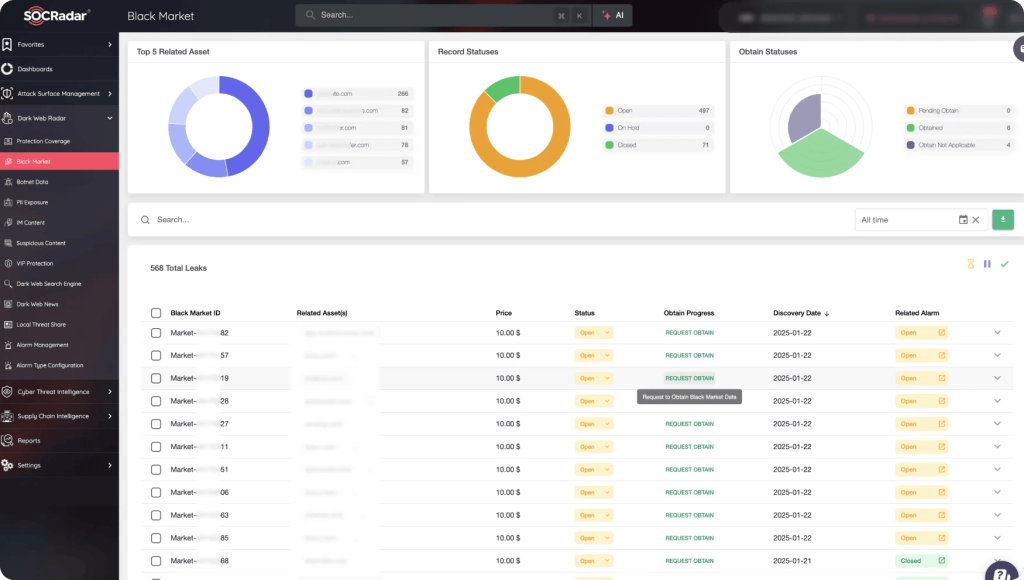
Primary focus: Broad, integrated external threat intelligence covering digital assets, dark-web activity, and supply-chain risks.
Pros:
- Users say that the clean, easy-to-navigate interface is a standout
- Reviewers consistently praise its continuous dark-web monitoring, including ransomware leak sites, and its takedown-ready alerts
- Faster onboarding compared to some competitors, based on G2 setup scores
Cons:
- Some reviewers describe custom rule and report configuration as difficult to navigate
- Alert noise, false positives, and duplicate notifications come up as a recurring complaint
- Some users want deeper and more up-to-date visibility into vulnerabilities related to third-party products
4. CloudSEK Cyber Threat Monitoring
CloudSEK combines external attack surface monitoring, digital risk protection, and threat intelligence from the surface, deep, and dark web. That combination matches the XTI definition and helps flag exposed assets, stolen credentials, impersonation attempts, and emerging attacks targeting your organization in the early stages.
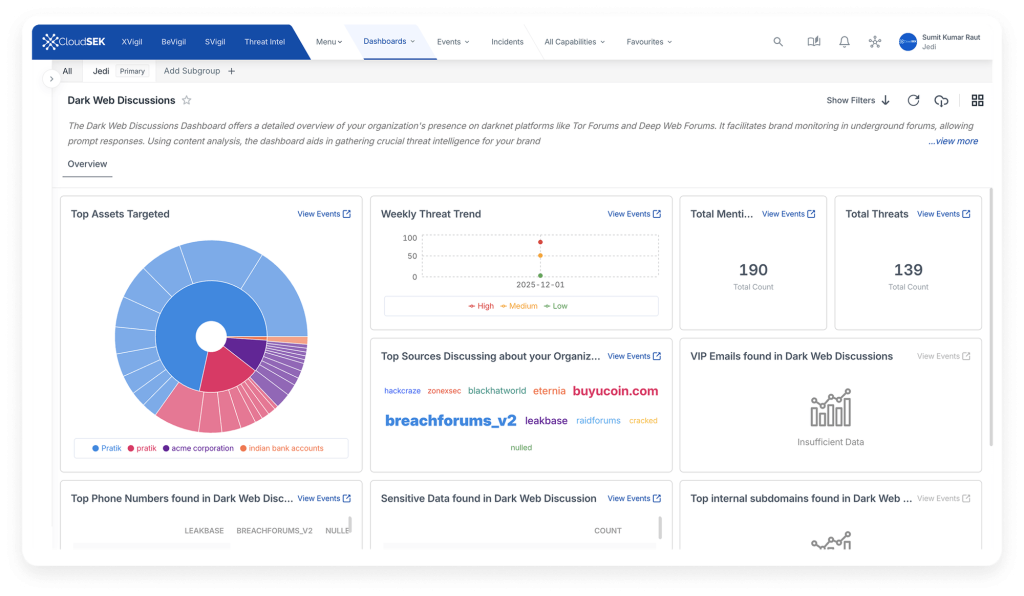
Primary focus: Predicting and detecting external attacks, data leaks, credential exposure, and brand abuse.
Pros:
- High marks for ease of use and smooth implementation across G2 reviews
- Strong dark web coverage for stolen credentials and forum chatter
- Users repeatedly highlight the responsiveness and quality of the company’s customer support
Cons:
- False positives in certain modules, particularly in credential breach alerts and domain impersonation detections, are a common complaint
- Multiple users report that the platform generates a high volume of alerts, which can be overwhelming
- Dashboard can feel cluttered and could use more polish, according to some reviewers
5. Brandefense Cyber Threat Intelligence
Brandefense is an external threat-intelligence platform that combines digital-risk protection, attack-surface management, and contextual threat intelligence to help organizations identify and respond to external threats.
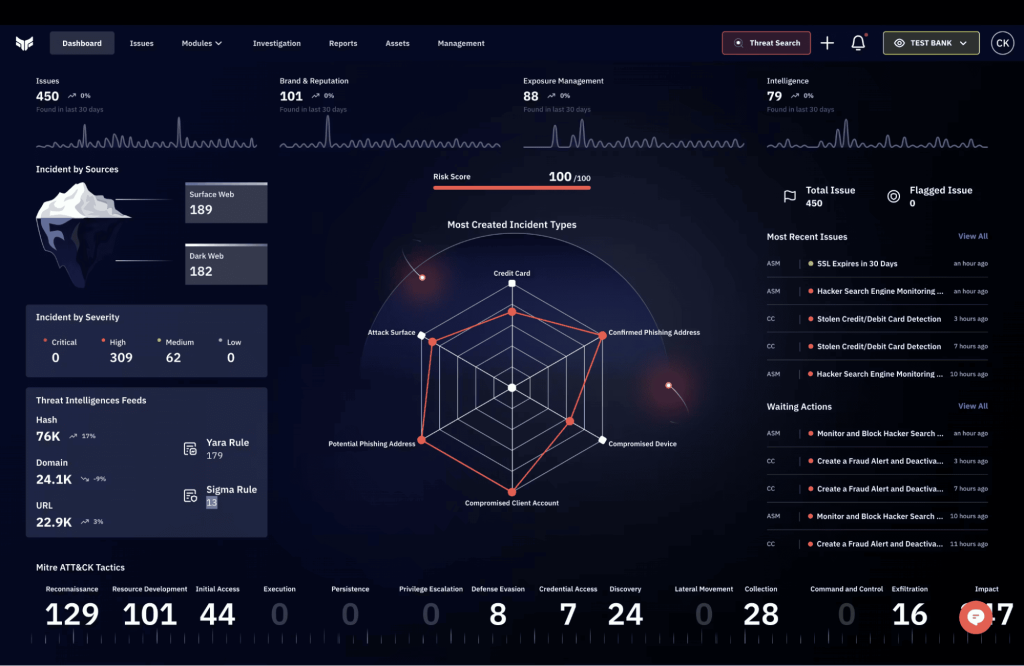
Primary focus: Unified threat intelligence and digital-risk protection for brands, identities and internet-facing assets.
Pros:
- User-friendly interface that reviewers say requires little training
- Strong dark web monitoring and brand monitoring capabilities
Cons:
- Users report that email notifications are not very detailed, so they have to log in
- Some alerts are delayed
- Reviewers complain about the quality of customer support
6. CYFIRMA DeCYFIR
DeCYFIR is a preemptive external threat landscape management platform that pairs predictive cyber intelligence with attack-surface, vulnerability, brand and digital-risk insights to warn organizations about threats developing against them. It enriches threat analysis with attacker context, tying threats to specific actors and tactics, techniques, and procedures (TTPs). Its combination of predictive intelligence, attack surface monitoring, and digital risk insights supports the XTI approach.
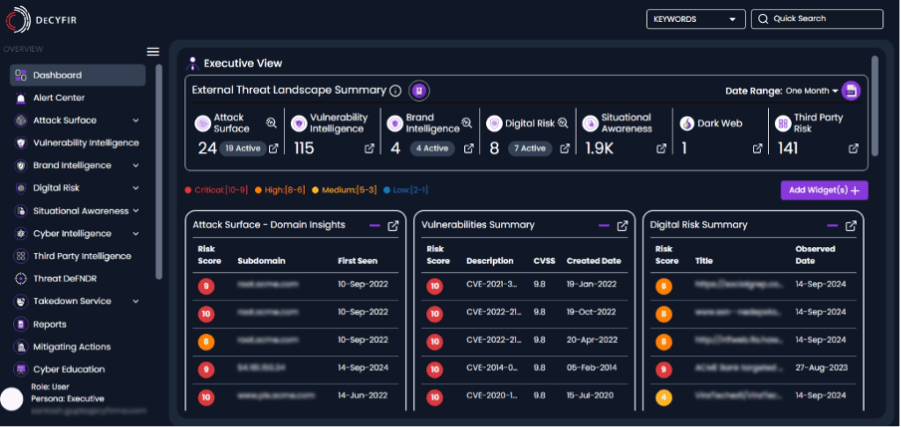
Primary focus: Predictive and preemptive intelligence about threat actors, campaigns, and risks likely to target the organization.
Pros:
- Reviewers highlight DeCYFIR’s outside-in view. They like that the platform links threats to specific actors, TTPs, and their own exposed assets instead of just listing indicators.
- It brings different types of threat intelligence into one interface, cutting down on tool switching.
- Many users praise the platform for its early warnings, which allow them to identify and address risks before operations are impacted.
Cons:
- One user noted false positives from indicators of compromise (IoC).
- Some users say that integrations with other security tools need improvement.
- Alerts can be noisy at times, requiring fine-tuning.
7. ZeroFox HNTR Platform
ZeroFox HNTR Platform is an external cybersecurity platform that correlates threat intelligence with brands, domains, executives, and other public-facing assets. It’s built to discover, validate, and disrupt threats across the web, social media, and digital marketplaces.
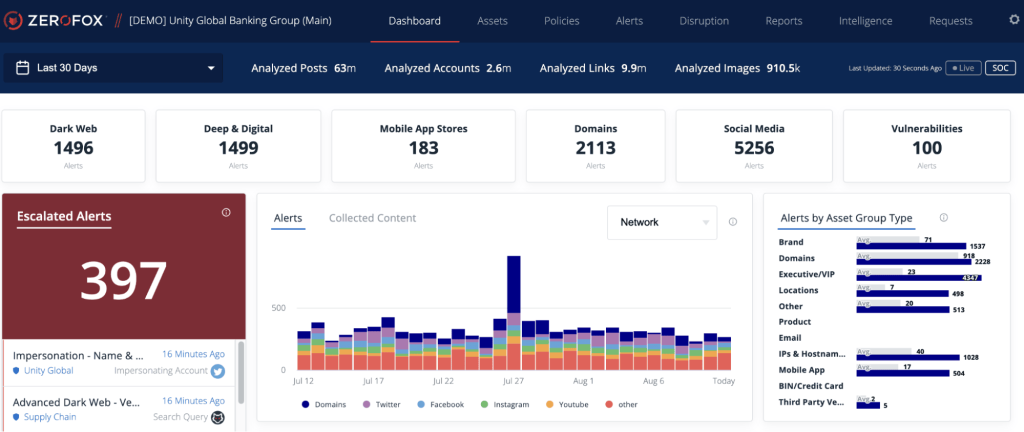
Primary focus: Detecting and disrupting brand impersonation, executive threats, fraud, and malicious activity across external digital channels.
Pros:
- ZeroFox HNTR Platform has an automated takedown feature, helping cut down hours spent on manual takedown requests, although some users say the actual takedown can take longer than expected.
- User-friendly for both technical and non-technical staff, according to G2 reviews
- Combines cyber threat intelligence, brand protection, executive protection, and threat disruption in one tool
Cons:
- Alert noise and false positives are some of the most common complaints, and users report that the platform needs regular tuning
- Some users report slower analyst review turnaround on escalated alerts
8. Rapid7 Threat Command Platform
Threat Command is Rapid7’s external threat intelligence and digital risk protection tool. It scans the clear, deep, and dark web to detect phishing, credential leaks, and impersonation before they escalate. A dedicated analyst team backs the platform, handling takedown requests and monitoring threat actor chatter on your organization’s behalf.

Primary focus: Organization-specific external threat intelligence, digital-risk monitoring and operational remediation.
Pros:
- Investigation and threat-mapping tools help cut through noise, although one user noted that it returned some vulnerabilities that ended up unrelated to their organization
- Backed by Rapid7’s broader security portfolio, useful if you’re already a Rapid7 customer
Cons:
- Pricing follows Rapid7’s typical model, which can climb once you add modules
- Best suited to security teams already comfortable navigating a larger platform ecosystem
- Review volume specific to Threat Command is thinner than for Rapid7’s other products, so you may want to book a demo to learn more about the platform.
9. Fortra Brand Protection (Previously Known as PhishLabs)
Fortra Brand Protection, built on PhishLabs’ original digital risk platform, guards brands against phishing, domain abuse, and impersonation. It covers the open web, social media, and the dark web, then pairs automated detection with expert analysis to speed up takedowns and reduce fraud.
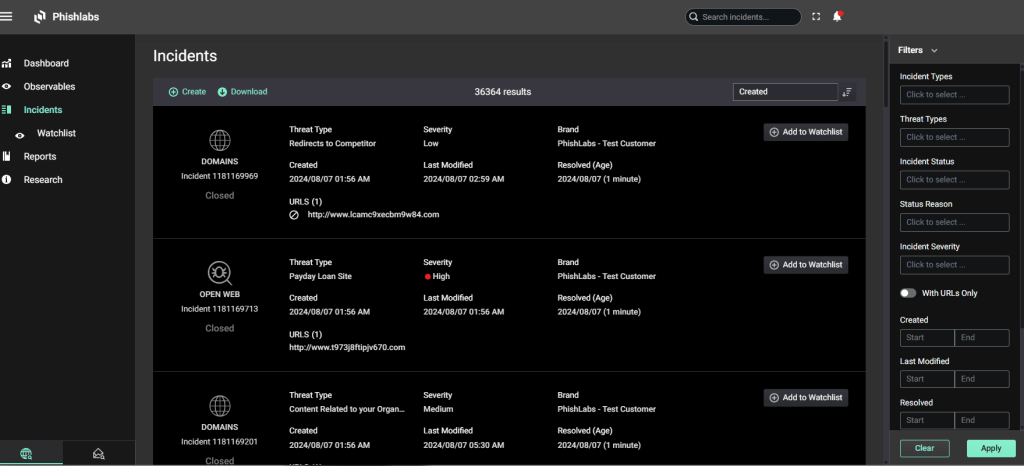
Primary focus: Managed phishing, impersonation, credential theft, and fraud detection with takedown support.
Pros:
- Reviewers highlight fast, responsive takedown support across more than 50 channels
- Users like the intuitive platform with timely and actionable alerts
Cons:
- The managed-service model benefits lean security teams since it means less hands-on tuning, although some users note the platform could use more automation
- Some report a learning curve when first navigating the web portal
10. Netcraft
Netcraft is an external threat-detection and disruption platform that specializes in automated takedowns and builds enforcement-grade evidence packages for hosting providers and registrars. It finds, verifies, and removes phishing sites, fraudulent infrastructure, brand impersonation, and malicious domains.
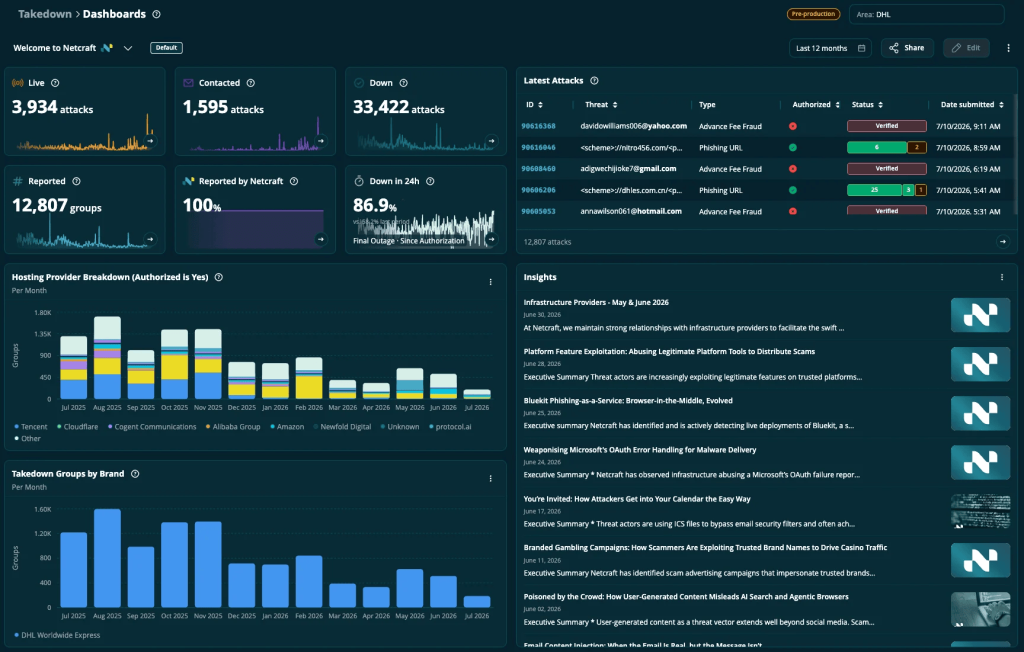
Primary focus: Detecting and taking down phishing sites, scams, malicious domains and brand impersonation infrastructure.
Pros:
- Fast phishing takedown time, according to different G2 reviewers
- Reviewers describe the interface as intuitive, even for new users
- Broad, accurate threat intelligence coverage across phishing, malicious infrastructure, and brand abuse
Cons:
- Some processes in takedown flows reportedly require manual steps, which delays resolution
- While Netcraft doesn’t publish its price, multiple reviewers on Gartner say that it’s quite expensive and may not be suitable for small businesses
11. Recorded Future
Recorded Future is a threat intelligence platform that correlates large-scale data about threat actors, infrastructure, vulnerabilities, and malicious campaigns with an organization’s assets and technology to detect relevant risks. It gathers this data from more than one million global sources.
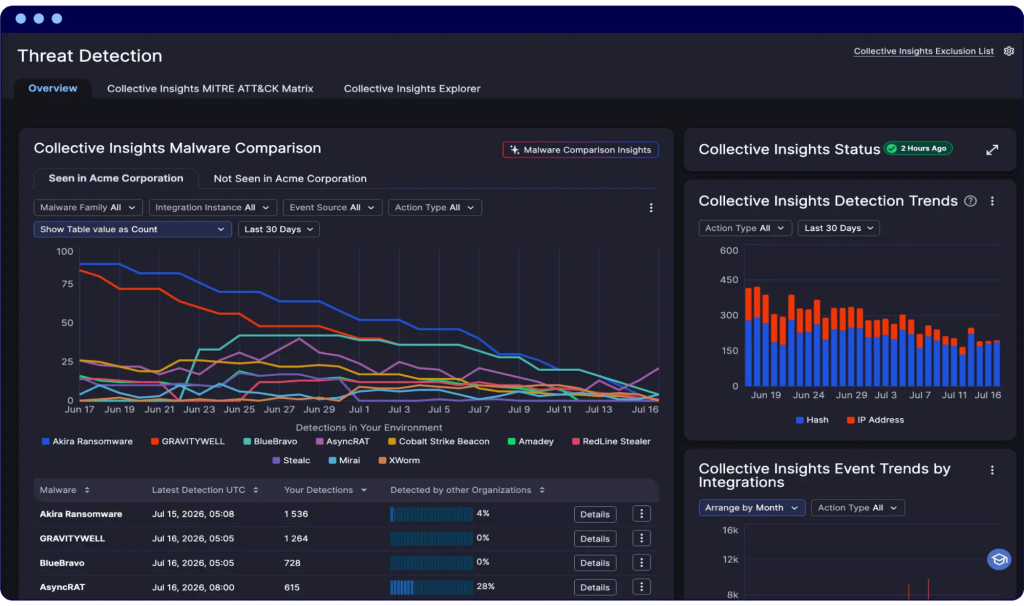
Primary focus: The platform focuses on four areas, namely cyber operations (including threat hunting), digital risk protection, third-party risk detection, and payment fraud prevention.
Pros:
- Consistently rated strong for breadth and depth of threat intelligence data
- Users highlight its integration features and API connectivity since these allow them to automate workflows
- Backed by Recorded Future’s Insikt Group., an in-house team of human intelligence analysts that produces original research, not just automated feeds
Cons:
- Reviewers frequently mention a steep learning curve, especially for new users or small teams
- Information overload is a recurring complaint, with dense dashboards that take time to master
How to Choose the Extended Threat Intelligence Platform
The best XTI platform depends on how effectively it brings together external attack surface visibility, digital risk protection, and threat intelligence for your particular case. Look beyond the number of features and evaluate whether the platform can connect different threat signals to your organization’s actual assets and risks.
What are you actually trying to protect?
Start by evaluating the platform’s EASM, DRPS, and threat intelligence capabilities. Can it discover exposed assets, identify brand impersonation threats, and enrich findings with actionable intelligence? Some tools provide broad coverage, while others specialize in one or two areas.
If the priority is your IT infrastructure, exposed assets, and which of them attackers are already probing, look for security tools like Attaxion LiveSight or CYFIRMA DeCYFIR that tie threat data directly to your asset inventory. If the priority is your brand, executives, or customer-facing channels, platforms built around impersonation and takedown, such as Netcraft, Fortra Brand Protection, and ZeroFox, may serve you better, even though both Attaxion LiveSight and CYFIRMA DeCYFIR also have modules for dealing with brand impersonation.
How much noise can your team handle?
Complex platforms like Recorded Future and SOCRadar XTI cover a lot of ground, but that breadth comes with a learning curve and, according to users that review those products, high alert volume to manage. Smaller teams without dedicated threat intelligence analysts may get more value from a managed service, such as Fortra Brand Protection, that handles investigation and takedown work for you.
What’s your budget?
Most vendors on this list don’t publish pricing, though Attaxion is an exception (Attaxion Core, a lighter version of the Attaxion exposure management platform that doesn’t have NetFlow monitoring and some other advanced features starts at $129 a month). For the others, you can try gathering pricing information from whatever public data points you can find (G2 pricing estimates, analyst reports, or peer conversations) before you call the sales team, so you’re negotiating from a position of knowing what similar tools tend to cost rather than reacting to whatever is quoted. They certainly won’t start as low though.
Does it fit your existing stack?
A tool that can’t feed alerts into your SOAR or SIEM platform, or that doesn’t integrate with the ticketing system your team already uses, adds friction instead of removing it. So check integration lists against your actual tech stack before you commit or talk to the vendor and see if they are willing to build integrations specifically for you. The tools that fit best tend to strengthen your overall security posture rather than adding another disconnected dashboard to check.
Conclusion
Extended threat intelligence brings attack surface visibility, digital risk protection, and cyber threat intelligence together to help organizations understand and respond to external risks more effectively. However, the tools in this list approach XTI differently.
SOCRadar, CloudSEK, and Check Point offer broad external threat intelligence capabilities. ZeroFox, Netcraft, and Fortra emphasize digital risk protection and threat disruption, while Recorded Future specializes in intelligence-driven security analysis.
Attaxion LiveSight combines EASM, domain-based DRPS, and threat intelligence with a distinctive advantage: NetFlow-enhanced visibility into real network activity. By connecting exposed assets, vulnerabilities, suspicious communications, and malicious IP intelligence, it helps security teams prioritize threats based on both external exposure and observed activity.
There’s no single best tool here. The right pick comes down to what you’re defending, how much manual triage your team can absorb, and whether you’d rather buy visibility or buy a managed outcome.
Use the pros and cons above as a starting point, then narrow your list to two or three vendors and ask for a trial or proof of concept before you sign anything. A tool that looks great in a demo can behave very differently once it’s ingesting your actual asset inventory and alert volume, and continuous monitoring only pays off if your team can keep up with what it finds.