

Source code disclosure vulnerabilities are security weaknesses that allow unauthorized users to access an application’s source code, which may contain sensitive information.
Source code is meant to run on the server side and at least the parts that contain sensitive information should be hidden from the public. If it accidentally becomes accessible, it can expose sensitive data, such as database credentials, secret keys, and internal hostnames that attackers can exploit.
Source code disclosure is classified as a type of information exposure attack and maps to the OWASP Top 10 A01:2025 Broken Access Control and Common Weakness Enumeration: CWE-540: Inclusion of Sensitive Information in Source Code.
Table of Contents
- Source Code Disclosure Example
- Why Is Source Code Disclosure Dangerous?
- What Causes Source Code Disclosure?
- How To Detect Source Code Disclosure Vulnerabilities
- Best Practices To Avoid Source Code Disclosure
Source Code Disclosure Example
Source code disclosure can happen in many different ways. There are many documented real-world cases of this, and among the most common ones are exposed .git directories.
Here’s a hypothetical scenario based on a real attack:
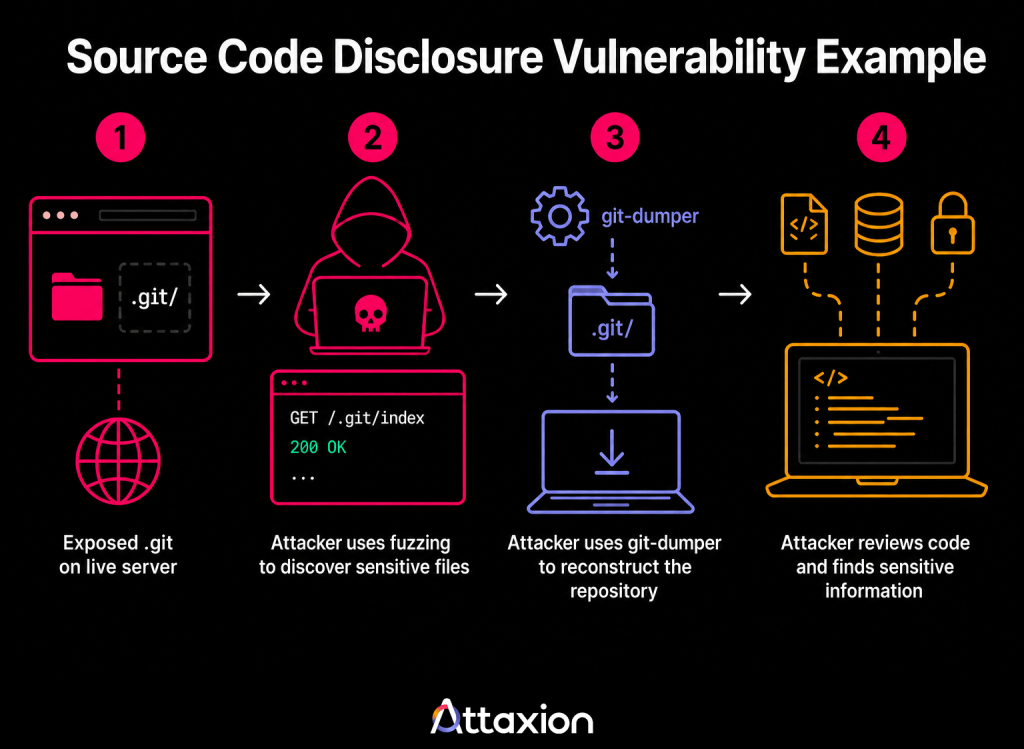
Imagine that a development team left public-facing directories containing .git directory backups and automated backup files inside the web document root on live servers, accidentally exposing the hidden /.git/ folder to the public internet.
When an attacker (or, in many cases, a bug bounty hunter) maps out the target organization, they use an automated URL fuzzer (a tool that tests long lists of potential file paths) and discover that the server responds with a 200 OK status when requesting .git index files — indicating that the server is misconfigured and is treating the sensitive file as regular data.
Using a tool like git-dumper, the attacker automatically requests the internal component pieces of the .git directory. Because Git tracks the complete snapshot history of the project, downloading these configuration components allows the attacker to fully reconstruct the raw web application source code locally on their own computer.
Once the source code is reconstructed, the attacker reviews the backend codebase. Within the newly exposed scripts, they can find things that were never intended for the public eye, including hardcoded internal system configurations, application logic, and database credentials.
A similar attack actually occurred back in 2021, when the United Nations Environment Program was breached.
Why Is Source Code Disclosure Dangerous?
Source code contains sensitive information, whether that’s database credentials, API keys, secret keys, or details about how the web application is built. When that information falls into the wrong hands, attackers have a significant head start in mounting a broader attack.
1. It Gives Attackers a Blueprint for Exploitation
Source code lets attackers see how the application actually works instead of guessing from the outside. They can inspect authentication flows, access control checks, file upload handling, input validation, session management, API routes, error handling, and backend service calls, and more.
This makes vulnerability discovery much faster and more precise for them. Instead of blindly probing the application, attackers can use the application’s exact logic to craft highly specific payloads. That can make attacks such as remote code execution, SQL injection, and command injection much easier and more likely to succeed.
For example, if the code shows that file uploads are only checked by extension, or that an admin-only function relies on a weak client-side check, attackers can target those weaknesses directly.
2. It Can Expose Credentials That Open Other Systems
Source code may contain hardcoded API keys, database credentials, or other secrets. Even if these credentials were added for testing or automation, they may still work if they were never rotated.
Attackers may be able to access systems directly without needing to exploit the application itself. A leaked database password could expose customer records. A cloud key could give access to storage buckets or infrastructure. A service token could unlock third-party tools, internal APIs, or backend services.
This can also turn a single source code leak into a broader compromise. Once attackers gain access to one connected system, they may use exposed machine identities, internal URLs, or service permissions to move into other environments that were not originally exposed.
3. It Can Expose Business Logic and Intellectual Property
Source code may reveal proprietary algorithms, fraud checks, scoring models, validation logic, or other business rules that make the application valuable or defensible.
Attackers can use that knowledge to bypass controls, game the system, or copy valuable functionality. In some cases, exposed code may also reveal trade-secret implementations that can be reused or sold to competitors.
For example, if the code reveals exactly how a fraud detection rule works, attackers can adjust their behavior to avoid triggering it. If it exposes a proprietary scoring model, others may be able to replicate or reverse-engineer functionality that was meant to remain private.
4. It Creates Supply Chain and Deployment Risk
Source repositories often include more than application logic. They may contain package manifests, CI/CD configuration, infrastructure settings, test scripts, and environment templates.
Attackers can use this information to identify weak points in the software delivery process. For example, they may find outdated dependencies with known vulnerabilities, insecure build steps, overly permissive deployment tokens, exposed artifact storage, or gaps in release controls.
This matters because the risk may extend beyond the currently exposed code. If attackers understand how the application is built and deployed, they may find ways to tamper with future releases, compromise the pipeline, or target the tools and services that support production deployments.
5. It Can Trigger Legal, Compliance, and Reputation Damage
Source code disclosure can become more than a technical incident if it exposes personal data, payment-related systems, credentials, regulated information, or evidence of weak security controls. It may also create contractual issues if customers, partners, or vendors expect the organization to protect code, systems, or sensitive data.
GDPR Article 32, for example, requires covered organizations to implement “appropriate technical and organizational measures” to secure data. If code disclosure exposes APIs, database credentials, or architectural flaws that compromise user data, it may result in GDPR violations.
Similarly, Payment Card Industry Data Security Standard (PCI DSS) Requirement 6 requires organizations to develop and maintain secure systems and software — this includes code repositories, so code disclosure that affects cardholder data or cardholder data environments (CDE) may constitute a PCI DSS compliance issue.
In the case of an incident, the organization may need to investigate the incident, rotate credentials, notify affected parties, engage legal counsel, respond to customer concerns, or undergo audits. If the disclosure leads to unauthorized access to personal data or cardholder data environments, it may also raise regulatory or compliance obligations. The reputational impact can last even after the technical issue is fixed.
What Causes Source Code Disclosure?
Web Server Misconfiguration
Web servers should be configured to execute certain file types, such as .php and .asp, rather than serve them as text. If a server isn’t configured to treat those files as executable, requesting index.php will return the raw PHP code in the browser instead of a web page. This applies to PHP applications, Java applications, and any other server-side language where the file handler is missing or misconfigured.
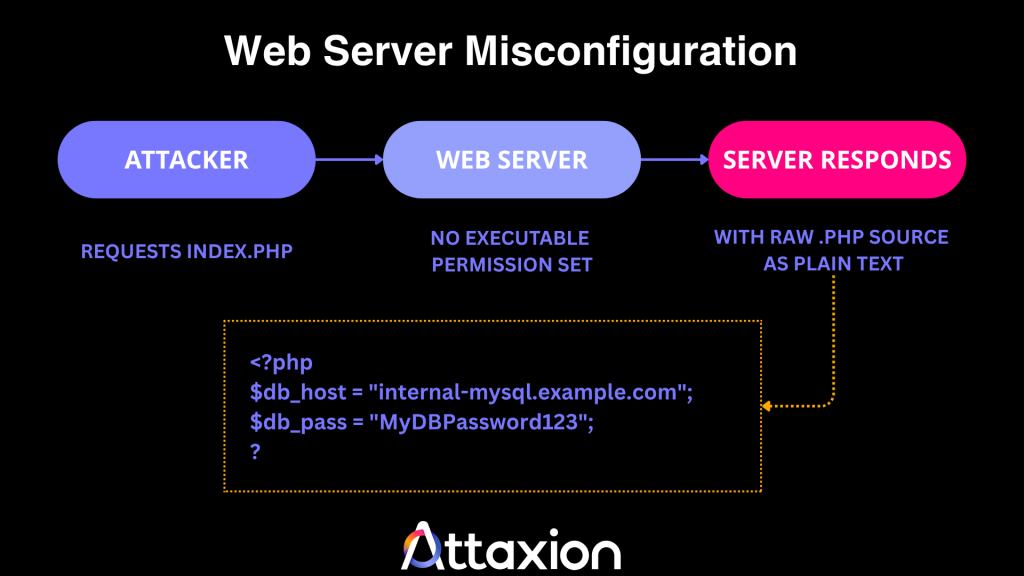
Source code disclosure through web server misconfiguration can also happen through HTML comments left in production code, version numbers exposed in HTTP response headers, or typographical errors in nginx web server or Apache configuration files that cause certain file types to fall through to a default plain-text handler.
Real-world example of source code disclosure due to server misconfiguration
In March 2024, a researcher discovered that setting runAllManagedModulesForAllRequests="true" in a Microsoft IIS web.config file causes a critical web server misconfiguration. By combining this setting with ASP.NET’s cookieless session feature, attackers can bypass default restrictions and download compiled DLL files, which can be reverse engineered to recover significant portions of the application’s code.
Local File Inclusion (LFI) and Directory Traversal
Local file inclusion (LFI) allows an attacker to display or download files from within the web server’s file structure, including interpreted source code files. Combined with directory traversal, LFI lets attackers reach files anywhere on the server, well outside the web document root.
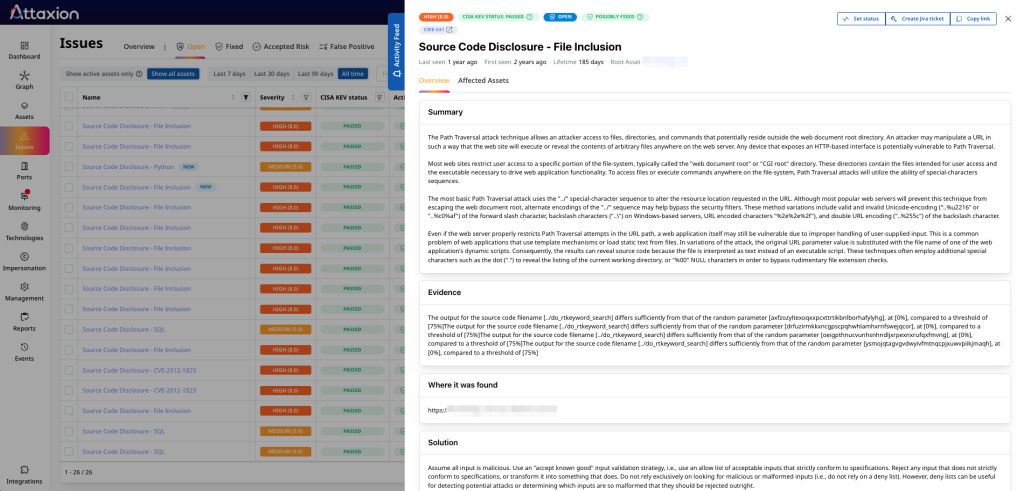
Attackers exploit LFI using special-character sequences, URL encoded characters, double URL encoding, or NULL characters to bypass security filters and input validation. For example, inserting ../../../etc/passwd or its URL-encoded equivalent into a filename parameter can trick the server into returning files it should never serve.
Real-world example of source code disclosure due to directory traversal
In April 2024, a high-severity LFI vulnerability (CVE-2024-2928) was disclosed in MLflow, an open-source platform for managing machine learning workflows. The vulnerability allowed attackers with network access to insert fragments like #../etc/passwd to bypass server-side path sanitization and access sensitive application files outside the intended directory.
Directory Listing
When directory listing is enabled on a web server, anyone can view the contents of a directory without specifying a file. This lets attackers not only read individual files but also map the full structure of the application, making it easier to find and access source code, configuration files, and backup files sitting in the web document root.
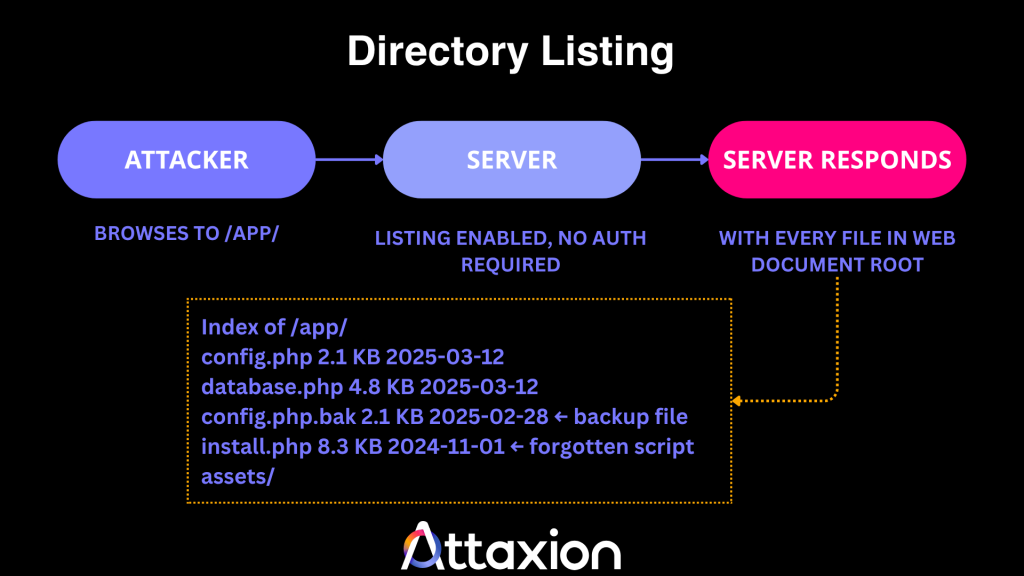
Full path disclosure is a related issue. When directory listing is enabled alongside verbose error messages, attackers can learn the absolute file system path of the application on the server, which makes path traversal attacks more effective.
Real-world example of source code disclosure due to directory listing
A directory containing more than 70,000 sensitive US Army files was exposed through an open directory listing vulnerability. The directory belonged to CMI Management Inc., a US government contractor.
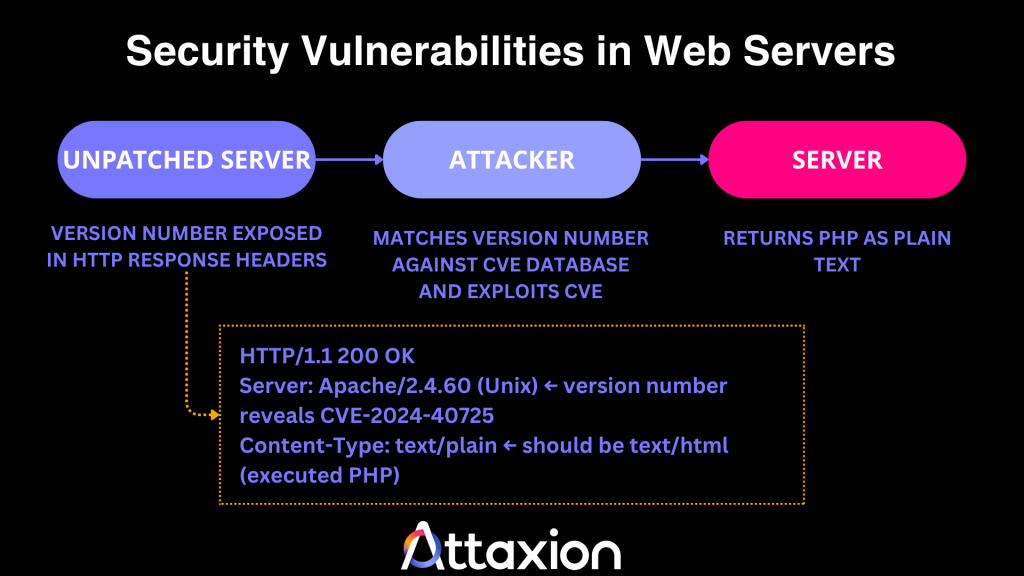
Security Vulnerabilities in Web Servers
Unpatched web server software can have CVEs that directly expose source code.
Real-world example of source code disclosure due to web server vulnerability
A regression introduced in Apache HTTP Server 2.4.60 caused the server to serve PHP scripts as plain text instead of being executed. This source code disclosure vulnerability, known as CVE-2024-40725, is fixed by upgrading to version 2.4.62.
How To Detect Source Code Disclosure Vulnerabilities
Because source code disclosure can stem from different types of vulnerabilities and misconfigurations, you may need a combination of tools and techniques. Below are the main categories of tools used for detection, along with what each one covers.
- Static Application Security Testing (SAST) tools: These tools analyze source code without executing it, scanning for patterns that commonly lead to source code disclosure, such as insecure file inclusion functions, missing input validation, and hardcoded credentials.
- Dynamic Application Security Testing (DAST) scanners: DAST tools test live applications for web vulnerabilities and server misconfigurations, including cases where the server serves raw source files instead of executing them.
- Directory and file enumeration tools: They brute-force directories and file paths to uncover exposed content, including publicly accessible version control folders and directories with listing enabled.
- Software Composition Analysis (SCA) tools: These identify open-source components with known vulnerabilities, including web server software or frameworks with CVEs that can be exploited to expose source code.
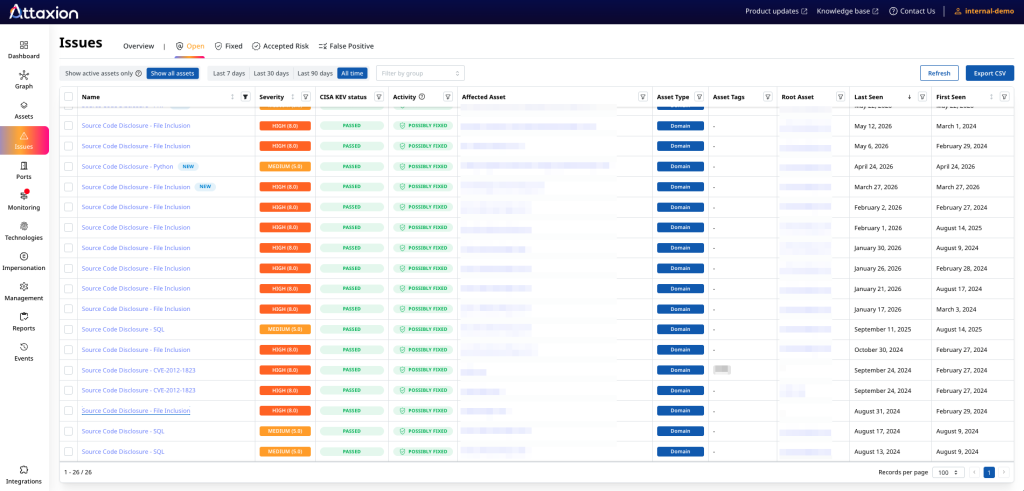
- Exposure management platforms: Tools like Attaxion continuously discover and monitor internet-facing assets for misconfigurations and exposure, including source code disclosure vulnerabilities.
- Manual penetration testing: Manual testing paired with automated scanning can catch logic-based and context-specific vulnerabilities that scanners alone miss. Security professionals rely on manual testing for complex authentication bypass and business logic issues.
Best Practices to Avoid Source Code Disclosure
- Keep web server software up to date. Patch regularly to close known CVEs in server software before they can be exploited.
- Make sure all source code files are set as executable by the server so they are not served as plain text to anyone who requests them.
- Turn off directory listing. There is no reason for a production web server to let visitors browse directory contents.
- Validate user input in web applications. Avoid passing filenames directly in user input. If you must, use a whitelist of allowed files. This helps prevent LFI and path traversal vulnerabilities.
- Remove HTML comments, debug output, and verbose error messages from production code before deployment as these can expose internal hostnames, version numbers, and file system paths.
- Enforce access controls on code repositories. Restrict who can access code repositories and make sure directories are never placed inside the web document root.
- Use an exposure management platform to continuously monitor your external attack surface. Your assets change constantly, new misconfigurations and accidental exposures can appear at any time — that’s why continuous automated scanning is the most reliable way to spot source code disclosure vulnerabilities in production on time.
Key Takeaways
- Source code disclosure occurs when unauthorized users gain access to application source code.
- It is classified under OWASP Top 10 A01 Broken Access Control and CWE-540.
- The main causes are web server misconfiguration, LFI and path traversal, directory listing, exposed source code repositories, and unpatched server software.
- Source code disclosure can give attackers the information they need to exploit vulnerabilities, access connected systems, abuse business logic, compromise the software delivery process, and cause legal, compliance, or reputational damage.
- To detect source code disclosure, you can use SAST tools, DAST scanners, penetration testing toolkits, repository scanning tools, and exposure management platforms.
- Prevention requires keeping software patched, setting correct executable permissions, removing HTML comments and debug output, and continuously monitoring your external attack surface.
Source code disclosure often happens through small configuration mistakes, so continuous external monitoring is one of the most effective ways to catch exposures before attackers do.
Find out if your assets have source code disclosure vulnerabilities. Kick off your 30-day free trial with Attaxion today.