



In high-stakes transactions such as mergers and acquisitions (M&A), speed often takes priority over security. But overlooking cybersecurity can turn a strategic investment into a liability. In fact, according to Forescout Technologies’ survey of 2,700 IT and business decision makers, 65% of acquiring companies experience buyer’s remorse because of cybersecurity concerns.
Whether you’re buying a company or preparing to sell one, understanding cyber risk is key to protecting the value of the deal. And after the deal is completed, there’s a lot of work that needs to be done by the cybersecurity team to establish full visibility and control over the freshly extended attack surface. In this post, we cover how M&A cybersecurity helps buyers and sellers reduce security risks before, during, and after a transaction — and what can and should be done at each stage.
What Exactly Does M&A Cybersecurity Mean?
M&A cybersecurity is the process of managing digital risk when two companies merge or when one acquires another.
But for the buyer and the target company, that can mean completely different things. The table below gives an overview of the activities involved in M&A cybersecurity for both parties at different stages.
| Activities | For Buyers | For Sellers |
| Pre-Sale | ||
| Cybersecurity due diligence | Identify hidden risks, past data breaches, and compliance gaps. Quantify the deal impact. | Conduct a self-audit to fix the high-impact issues, document security controls, and prepare disclosures. |
| Signing and Pre-Close Preparation | ||
| Pre-close planning | Evaluate infrastructure and dependencies and prepare for the transition. | Separate seller-only data and prepare data migration. |
| Post-Sale | ||
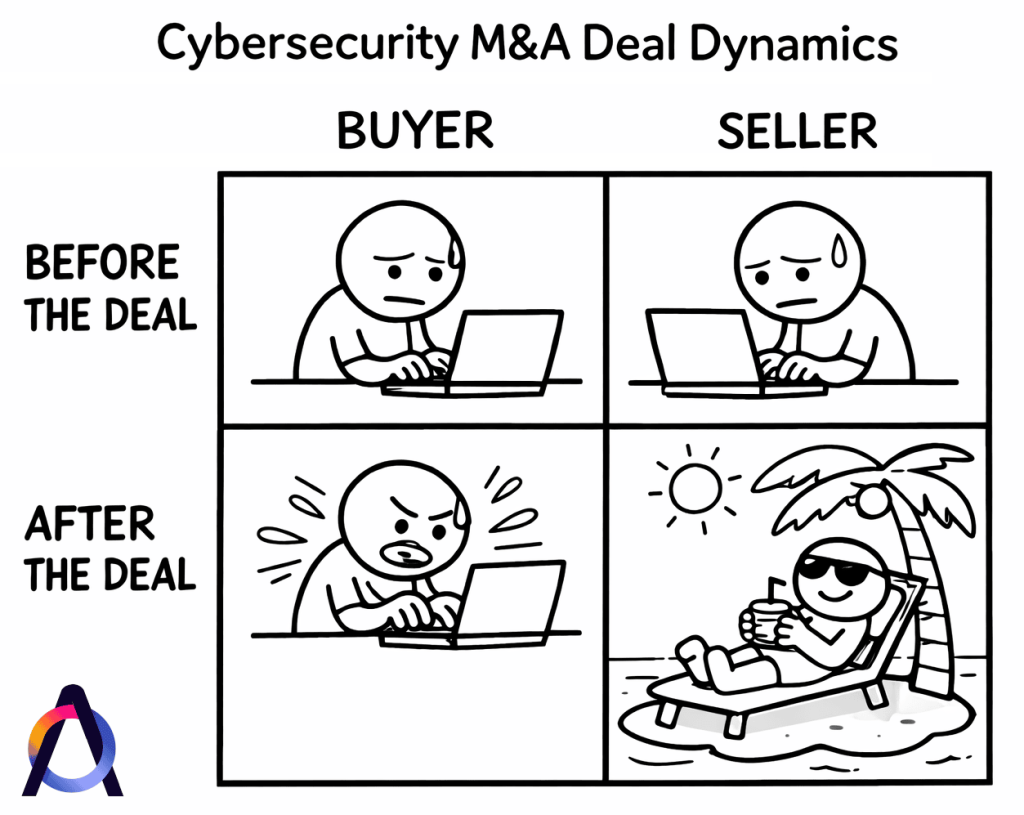
| Onboarding and integration | Decide between full network integration and isolation. Establish full visibility and observability. Standardize tools like ASM, EDR, and identity security. | Provide transition services (hosting, network connectivity, security monitoring) while systems are migrated. After the transition is complete, chill on the Bahamas, enjoy the exit money, and plan the next big thing. |
M&A Cybersecurity at Different Deal Stages
Cybersecurity Due Diligence
Before a deal closes, buyers want to know what they are truly buying, and sellers want to prove their company is a low-risk, high-value investment.
Pre-M&A due diligence helps determine whether the deal proceeds and whether the purchase price needs to be adjusted.
For buyers, the goal of the M&A due diligence process is to uncover hidden liabilities and risks:
- Past breaches that were never fully resolved or disclosed
- Compliance gaps that could lead to fines
- Weak security controls that require expensive remediation
If major security gaps exist, the acquisition price must reflect the cost of fixing them.
Sellers, in turn, run what’s called vendor cybersecurity due diligence preparation, which can improve valuation and ensure that there are no unpleasant surprises when the buyer is conducting their evaluation. Fixing vulnerabilities and organizing security documentation helps buyers assess risk faster. According to a recent study by Gabrielle Lattanzio from the University of Melbourne and Jérôme P. Taillard from Babson College, lower-risk companies are more attractive acquisition targets.
Deal Execution / Pre-Close Planning
When both parties agree to proceed with the deal, both organizations (ideally) should have dedicated teams focused on technical separation.
Buyers need to evaluate whether the business can be securely separated from the seller’s infrastructure and what technical dependencies may complicate the transition. A clean separation prevents unauthorized lateral movement and protects the new parent company from residual security risks in the seller’s legacy environment.
Such a clean separation is not always possible, though. So, there may be a need for a Transition Services Agreement (TSA) between the buyer and the seller, under which the seller temporarily continues providing services such as hosting, network connectivity, identity management, or security monitoring. This arrangement allows the buyer time to build its own infrastructure and migrate systems and data safely.
For sellers, it’s mostly the same, but from the other side. They also need to isolate the data to be sold from the data that is not part of the acquisition and prepare the assets for migration.
Handling permissions early reduces the chance of data leaks and helps ensure a smooth operational transition. In modern M&A transactions, a clean digital separation is as important as the financial handover.
Post-Sale Cybersecurity M&A
Once the deal closes, the focus shifts to onboarding and integration.
Buyers must decide whether to fully integrate the new company into their network or keep it isolated, and this decision depends on the maturity of the acquired company’s security posture.
Regardless of the path, there are important things to do:
- Inventory the acquired company’s assets, tools, and procedures to capture a complete picture of their security architecture and establish full visibility and observability.
- Unify and standardize security tools across both environments to prevent gaps.
Sellers can make this transition smoother by maintaining a clear inventory of assets and security controls well before the sale. That way, the acquired team can accurately and efficiently migrate data to the buyer’s secure IT infrastructure.
Training employees on the parent company’s security policies also helps reduce human error during the transition.
If the companies have agreed on the TSA, the seller’s role is to adhere to the agreement. Otherwise, their job there is done, and they can enjoy the exit however they prefer.
What Cyber Risks Do M&A Transactions Pose?
During a merger or acquisition, both companies are exposed to several risks, and the Marriott data breach is a classic example.
In 2018, attackers compromised the personal information of about 383 million Marriott hotel guests. The breach actually began in 2014 inside the Starwood Hotels reservation system — two years before Marriott acquired the company in 2016.
Hackers exploited legacy security gaps and insufficient monitoring to steal names, addresses, unencrypted passport numbers, and other personal data. This inherited liability resulted in hundreds of millions of dollars in recovery costs and legal settlements, as well as a £99 million fine from the UK’s Information Commissioner’s Office.
From this case study alone, we can derive four risks:
- expanded attack surface
- tooling incompatibility
- inherited breaches
- human error
Expanded Attack Surface
When you acquire a company, you inherit its servers and web apps, endpoints, cloud buckets, IoT devices, and all the other assets, which can serve as entry points for threat actors. Therefore, one of the most immediate risks in any merger is the sudden expansion of the attack surface.
It doesn’t help that many target companies have incomplete asset inventories — they might not know exactly how many old web servers or forgotten databases are still running, and the acquiring company inherits these forgotten and shadow IT assets that lack proper security controls.
During the onboarding rush, information security teams frequently move data to the cloud or reconfigure firewalls to connect the two networks. Speed usually wins over security in these moments, but a single misconfigured firewall rule or an open S3 bucket can leave a door open for attackers.
Inherited Dormant Breaches
The Marriott case is a good example of a breach living inside a network for years before the deal closes. The buyer may inherit compromised assets, and when these silent breaches eventually surface, the acquiring company remains responsible for the legal and financial liability.
If a breach or risk of a breach is discovered before closing mergers and acquisitions, the value of the deal can totally change. For example, in 2017, Verizon reduced its offer for Yahoo by $350 million (approximately a 7% price drop) after two massive data breaches were revealed during negotiations.
According to Aon, buyers may require sellers to leave up to 20% of the purchase price as a security deposit to pay for any hidden liabilities or data breaches discovered after the deal closes.
Tooling Incompatibility
Security teams struggle when two different tech stacks meet, especially since merging companies rarely use the same vendors for firewalls, attack surface management, endpoint protection, or identity and access management. If your team uses one platform but the acquired company uses another, you lose centralized visibility.
Managing a new environment that your current tools cannot support creates blind spots. As we often say, you cannot protect what you cannot see, so if your security operations center (SOC) does not receive logs from the new branch, a threat could go unnoticed for weeks — or years, as in Marriott’s case.
Human Error and Insider Threats
Mergers create uncertainty and turnover. When key IT staff leave the company, they take their knowledge of the infrastructure with them. The security team left behind may not understand the quirks of the inherited systems, making it easier for errors to occur during the transition.
Uncertainty also increases the risk of insider threats. Employees who fear for their job security may intentionally leak data or bypass information security protocols. Even without malice, overworked teams are more likely to make mistakes — a tired admin might grant excessive permissions just to get a system running, which creates a critical security vulnerability.
M&A Cybersecurity Risk Assessment Process
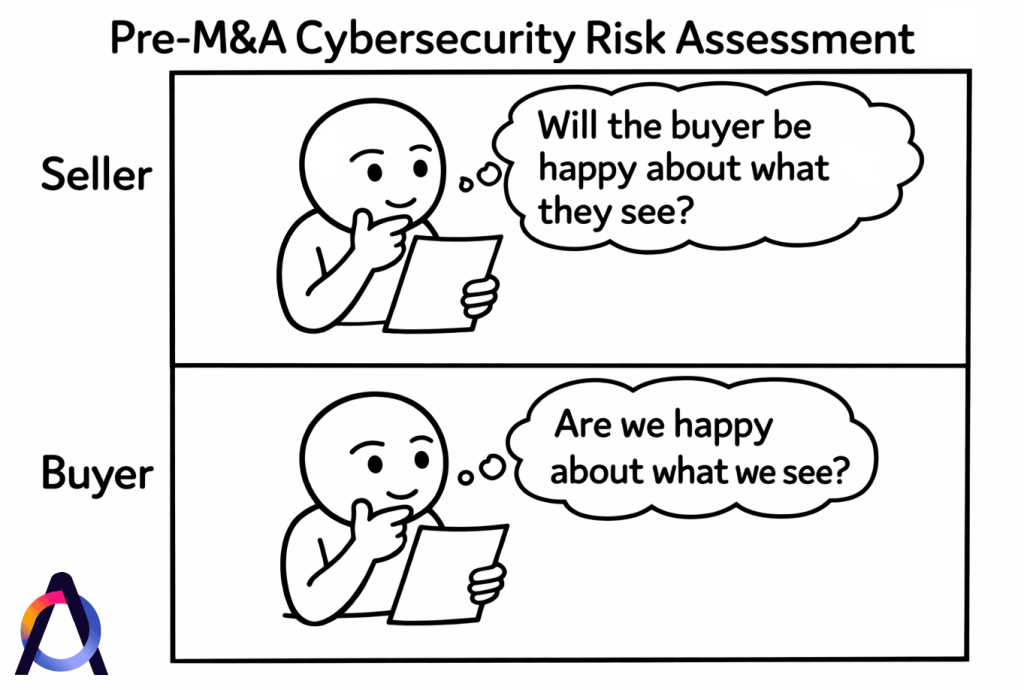
We’ve talked about how cybersecurity M&A tasks mean different things to different people, and the same is true for the risk assessment process. M&A cybersecurity assessments occur both before and after the deal, but their goals and scope differ significantly. Also, the buyer and seller want to get answers to different questions during very similar processes.
Pre-M&A Risk Assessment
The Pre-M&A cybersecurity risk assessment occurs before the deal closes, with the main objective of avoiding potential legal liabilities and security issues. For the buyer, the data gathered in this assessment helps leadership decide whether to proceed with the deal. It also provides leverage to negotiate a lower price or request specific repairs before the closing date.
The seller typically performs a vendor cybersecurity assessment first to prepare documentation and address major issues, while the buyer conducts an independent evaluation to verify the target’s risk exposure.
Questions Answered
For the seller:
- What security controls and documentation are ready for buyer review?
- What incidents or risks must be disclosed?
- Are there major cybersecurity issues that could affect the deal?
For the buyer:
- Are the seller’s cybersecurity claims accurate and complete?
- How severe are the target’s cybersecurity risks?
- What financial exposure could these risks create?
What Is Assessed?
To assess the target company’s risk exposure, the team evaluates:
- Cybersecurity posture maturity: What cybersecurity policies are in place? Do they follow frameworks like NIST, ISO 27001, or SOC 2? Are they compliant with regulatory requirements such as GDPR and HIPAA?
- Cybercrime incident history: Have they been hacked before? How were the breaches handled? How good are their incident response and recovery capabilities?
- Data privacy and protection practices: How do they handle sensitive data, such as personally identifiable information (PII), credit card holder data, or health records?
- External risks: Do they have ongoing litigation related to online attacks or any cybersecurity events? Are there third-party risks? Does cyber insurance cover these exposures?
- Information security infrastructure: What security solutions do they use for threat detection and mitigation? What’s the state of their cloud environments? How much would it cost to integrate everything?
- Identity systems: Are identities centrally managed? How hard would it be to separate the business?
Pre-M&A Risk Assessment Outcomes
By the end of the pre-M&A risk assessment, the target company will have a structured risk profile, which highlights critical security gaps.
The assessment provides a cost estimate for necessary security fixes, which is usually reflected in the final deal value. In some cases, the findings lead to conditions of sale, where the buyer requires the seller to fix specific issues before the money changes hands. If the risk is too high, the deal may be terminated.
Also, based on this assessment, the companies decide whether there’s a need for a transition service agreement — and what should be there in the TSA if the answer to this question is “yes.”
Post-M&A Risk Assessment
Now that the deal is done, the priority is to securely integrate networks, systems, and digital identities while addressing inherited technical debt. The risk assessment process during this phase helps protect the value of the merger by preventing breaches and ensuring regulatory compliance during the chaotic integration period.
Questions Answered
- What did we inherit?
- What new risks did the integration create?
- What must we fix first to secure the combined organization?
- Which cybersecurity-related processes need to be established or changed?
What Is Assessed?
This is a more granular review, where the acquiring team assesses the details of the following:
- Network connectivity: Check how the two networks talk to each other and whether they are properly segmented.
- Identity management: Make sure employees from the new company have the right access levels without creating privilege escalation paths for attackers.
- Third-party vendors: Identify which outside contractors now have access to the newly connected systems.
- Cloud consolidation: Check for misconfigured cloud settings as the two companies merge their digital storage.
- Vulnerability exposure: Identify security weaknesses, misconfigurations, or outdated software across the combined assets, and check whether the red flags found before the deal closed are still a problem.
- Compliance exposure: Determine whether new data privacy policies and data processing structures comply with GDPR, HIPAA, or other regulations.
- Shadow IT: Find hidden apps or cloud accounts that the new employees might be using without official approval.
- Tooling gaps or duplicated controls: Decide which security software to keep and which to cut, while ensuring no gaps are left behind.
- Security monitoring coverage: Confirm that the acquiring company’s Managed Detection and Response (MDR) team or Security Operations Center (SOC) can see alerts from both companies.
Post-M&A Risk Assessment Outcomes
The result is a documented security posture for the new, larger entity. You get a clear map of the expanded attack surface, including a catalog of newly discovered assets and a prioritized list of vulnerabilities to fix.
The post-M&A risk assessment should produce a summary of the combined cyber risk for the board of directors, which may include any control gaps and compliance exposures introduced by the integration.
How Attaxion Helps with M&A Cybersecurity
As an exposure management platform, Attaxion can help both sides either with preparation for the merger, or, perhaps more importantly, with securing the external assets after the merger. Here’s what Attaxion offers to simplify the cybersecurity side of the M&A process:
- Agentless asset discovery: Attaxion uses agentless discovery to map a target company’s external attack surface within hours, way before the current standard due diligence timeline of 72 hours. This gives both buyers and sellers the visibility they need to make decisions without stalling the transaction.
- Shadow IT discovery: Target companies may have forgotten servers and abandoned subdomains that lack proper security controls. Attaxion identifies these shadow IT risks so that you can secure or decommission them before they become a liability. Rand Machine used Attaxion this way and uncovered assets inherited from M&As that they were previously unaware of, regained visibility into the attack surface of the joint enterprise, and quickly got external vulnerability management back under control. Read Rand Machine’s story here.
- Risk-based prioritization: After closing the deal, security teams are usually overwhelmed with a long list of vulnerabilities. Attaxion helps them focus on what matters most by prioritizing risks based on their actual exploitability so teams can tackle the most critical threats first during the high-pressure integration phase.
- Continuous monitoring: The window between a deal announcement and the final close is a difficult one for cybersecurity teams — research shows that 53% of organizations encounter a critical security issue during this period. Attaxion provides continuous monitoring throughout the transaction, ensuring that new issues are caught the moment they appear.
- Scalability: Attaxion scales as quickly as your asset portfolio grows during mergers and acquisitions deals. The platform lets you increase your billable asset count with a single click, allowing you to maintain full visibility into new acquisitions while knowing exactly what you’re paying for.
Sign up for a free 30-day Attaxion trial or talk to our experts to learn more about discovering and managing exposures during and after M&As.